Archive for August, 2009

More good news for housing!

Wednesday, August 26th, 2009

These articles were recently released. It’s a breath of fresh air to see good news about the housing market! …

“Sales of newly built U.S. single-family homes rose in July to their fastest pace in 10 months. The reports offered fresh evidence that the worst recession since the Great Depression of the 1930s has probably ended or is close to ending.” Read Article on Reuters

“U.S. New Home Sales Jump 9.6%, Most in Four Years. The gain in sales, together with rising purchases of existing homes and steadying prices, indicate the housing slump may be ending.” Read Article on Bloomberg

“A 3.8 percent jump for the month in San Francisco and a 2.6 percent rise in Boston; the industrial Midwest, with Cleveland prices up 4.2 percent; and even the epicenter of the crash, the Sun Belt, with Phoenix homes up 1.1 percent. Eighteen of the 20 cities tracked by Standard & Poor’s Case-Shiller Home Price Index showed improvement in June, up from eight in May, four in April and only one in March.” Read Article on NY Times

“U.S. Stocks Advance as New-Home Sales Surge More Than Forecast.” Read Article on Bloomberg

All signs indicate that we’re on the verge of an upswing in the housing market. Don’t miss out on this once in a lifetime opportunity. Access deals for pennies on the dollar while prices are still at all-time lows by starting your free trial today at www.myhousedeals.com/freetrial.

Until next time, happy (and profitable) investing!

Doug

How to Get Money for Your Deals – Part II of the Rice Interview

Wednesday, August 19th, 2009

Hi Folks,

A couple of weeks ago I shared Part I of my interview with Larry and Brent Rice – How to Make $100,000 in Six Months or Less. As promised, here’s Part II:

ME:  Are there really such things as no money down commercial deals?

LARRY:  Well, it’s hard to do that. Most 3rd party lenders on big deals (one million dollars or more) will require some commitment by the investment group. Generally, it’s going to take about 15%, so on a million dollars you’re talking $150,000. The question is where do you get the $150,000?

Well, one of the places that I have been successful with is some people with a lot of money. Those are my partners and when I find those partners, we’re able to secure a total of a 100% loan on the strength of their financials and our expertise. There are some regulations that keep banks and 3rd party lenders from loaning us 100%. So really, the only place to go is a secondary source such as an equity partner, somebody that would join you in the deal. But be careful; if you start selling securities, you need a securities license. And that’s what you’re doing when you start giving shares of ownership in investments, so be careful with that.

ME:  Okay, you’re saying you can bring on a partner. How would people listening to this interview find a partner with that kind of money to bring into a deal?

LARRY:  Most of it’s based on trust. If you know someone who has a lot of money but doesn’t want to spend the time searching for places to invest, and who trusts you and your energy and your entrepreneurial spirit, he might very well give you an opportunity to go out and invest his money. This is exactly what happened to us. Brent and I had the respect of two very wealthy men, one a doctor and one who owned a very large car dealership, and they put their financial strengths with ours and we were able to make something happen. I would also recommend that the deal you’re buying be very strong.

BRENT:  I’d like to add something to that. I know a lot of you are in different parts of the country, but there’s a lot of money flowing into Texas that is motivated by tax deferrals. We don’t need to get too much into the whole 1031 tax-free exchange concept, but that is where the capital is coming from. People are just trying to defer their capital gains tax, and you can do that after you sell a property by placing the proceeds from that sale into another investment property within a certain period of time. These are people with money looking for their next deal with a sense of urgency, and they are a great resource.

Also, I’ve heard of deals on apartment projects with 90% loan to value. Again, that leaves a 10% equity requirement; in some cases you can get the seller to carry back a second, or you can go to a bank and get them to give you 100% loan. The bank will be looking for some credit strength somewhere.  If you don’t have it, again a partner is a great source. Also, a bank you have a good relationship with can provide you with a ‘letter of credit,’ which you can then put up as collateral in lieu of cash equity.

ME:  Excellent. Thanks for sharing that with us Brent. Let’s go back, how do you go about finding these partners or are they all part of some sort of group you can find on the Internet?  How does that work?

LARRY:  One of the recommendations that I would make would be to actually try to find a project or property first. Once you have one, then you can advertise that property; you can’t advertise a property you don’t own. Then you can use the Internet to let it be known that you are forming an investment group for the purpose of purchasing a particular property, and describe the property in general. I would suggest you go on Loop Net (www.loopnet.com), and you’ll find a lot of various kinds of properties there.

ME:  Would a lot of good properties be advertised on a website like Loop Net? Is this where these package deals are and is this where the buyers go?

LARRY:  When you’re trying to find a property to buy, there’s no good multi-family website or multi-listing service. I’m a member of several, and by the time I call those they’re already in contract. It’s really hard to find a multi-family project since they’re in such great demand.

Again, it’s not a bad idea to build your own portfolio like you’re doing with single family, but commercial is also a great way to go. There are a lot of reasons people want to sell real estate; someone who’s just getting old and doesn’t want to handle it anymore, or they’re tired of it and they don’t want to manage it anymore, these are great sources.
_________________________________________

And there you have it! A little primer on Commercial Investing. If this area of real estate investing interests you, I highly recommend you listen to the entire interview. What you read here is just a small sample of the many tips Larry and Brent, two commercial real estate pros, shared during our talk.

You can get the audio for this complete interview and eleven others by ordering The Vault. The Vault contains in-depth interviews with expert investors from across the nation and covers topics ranging from rehabbing to subject 2 investing to private money and more. Learn how you can get your hands on the Vault at a 36% discount by going to www.myhousedeals.com/thevault.

Until next time, happy (and profitable) investing!

Doug

Nothing Beats Hard Work

Wednesday, August 12th, 2009

Hello again fellow investor!

When trying to succeed as a real estate investor, or anything else for that matter, nothing beats hard work. Back in 2002, I was a lowly entry-level computer programmer for ExxonMobil. To some, that may sound like a sweet gig. To me and every other co-worker who was brave enough to admit it, it was a prison.

We would huddle in our offices, shut the doors, and spend up to two hours at a time plotting our escape. We all planned on leaving the corporate world behind for good, and we all had different means of accomplishing that goal.

I was interested in the world of residential real estate investing and the big paydays it promised. William wanted to build up a nice cash flow through a health-related MLM business. And Jeff wanted to get involved with imports and exports. I still don’t know where he got that idea. (Possibly from Seinfeld … for those who watch!)

Regardless of our chosen paths, we knew that someday we would all break free of those shackles, leave the rat race behind for good, make our millions, and spend the rest of our existence reclining in the lap of luxury. Our lives were miserable for the time being, but the future shined bright!

Fast forward to 2009! So what happened?

I busted out within six months from plotting my escape. They still work in Corporate America. That’s good news for me. But it’s a highly unfortunate situation for my buddies. Actually, I feel sorry for them because I know they’re not happy. (I still get the occasional update.)

And I also wonder why I was able to bust free while they remain chained? We all seemed so motivated during those discussions! I’ve always wondered this, but I’ve really thought hard about it for the last week. And I’ve finally come up with an answer. It’s one you probably won’t like. The secret? …

HARD WORK

While my friends hit happy hour, played volleyball, watched TV, and then hit happy hour again, I worked on my real estate business. I “dialed for dollars”. I called FSBOs, MLS fixer uppers, and wholesalers. I also called up other investors and spent hours quizzing them for the best ways to find houses, the names of the best contractors, the best negotiating tips, the best parts of town to invest in, and more.

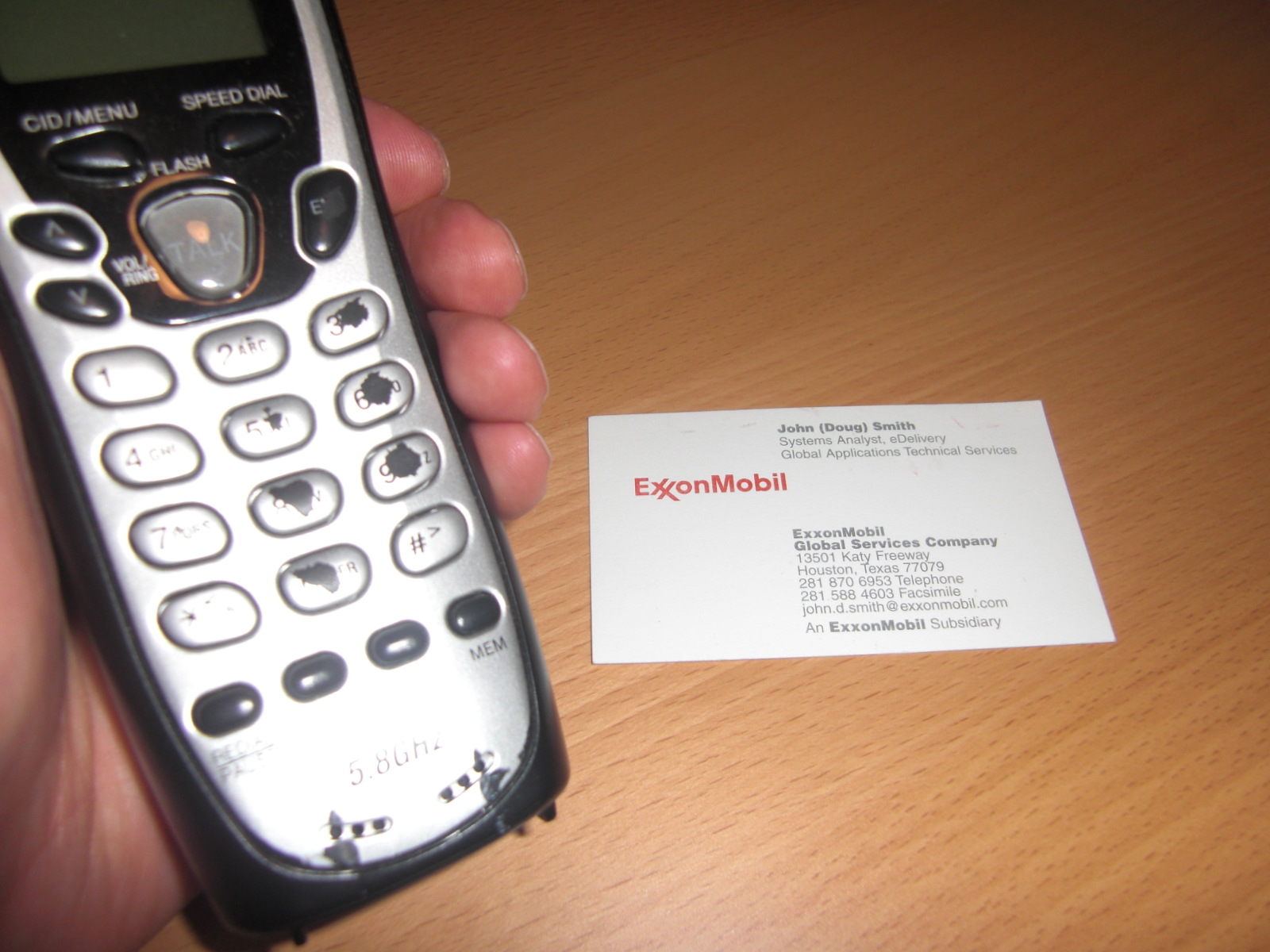
I dialed so many people that the digits started wearing off of my phone’s keypad. But I still knew where the keys were, so I didn’t let that hold me back. I kept dialing. And each time I dialed, I’d keep an Exxon business card next to me to remind me of why I was dialing in the first place. To escape the slavery!

I’m not normally sentimental, but I did manage to hold on to that phone and that business card to this day. Here’s a pic I just took of them. Ah, the memories!…

Would I want to put in the long, hard hours again as my buddies kicked back and had the time of their lives? No. But was it necessary to get where I am today? Absolutely! I now live in a world of unlimited opportunity and maximum optimism. I’ve fired my boss. I’ve ditched the long commute. I pursue real estate investments and other business ventures on a daily basis. I spend four times as much time with my family and ten times as much time on vacation. Best of all, I’m permanently “unemployable”. Life is good.

But enough about me. Back to you…

Please remember this: Whether you’re like me and you’re looking to get away from something (dead-end job, financial troubles, working for “the man”) or you’re trying to move toward something (luxurious vacations, time with family, plenty of leisure time, ability to spend like a king), there’s one thing you absolutely cannot forget to do at the beginning of your journey … put your nose to the grindstone and WORK HARD. It’s the best return on investment you’ll ever get.

Until next time, happy (and profitable) investing!

Doug

How to Make $100,000 in Six Months or Less – Part I

Wednesday, August 5th, 2009

I had the oppurtunity to interview Larry and Brent Rice, a father-son team, for my Vault series and today I want to share with you part of the conversation I had with them.  Larry and Brent know the secret to making $100,000 or more in less than 6 months.

Larry Rice has been involved in real estate brokerage and investment since 1978, having owned, managed and/or brokered single family and multi-family properties, office buildings, retail strip centers and development land.  His son, Brent Rice, has been buying commercial property since 1990.

During that time, Larry and Brent have purchased and sold over $15 million dollars in commercial real estate.  Their transactions have included several retail and office buildings and single family houses.  They have also brokered or funded over $75 million in commercial real estate; they know commercial real estate inside and out and we are fortunate that they’re willing to share their knowledge and experience with us here.

ME:  Let’s start with the topic of this interview – how can you make $100,000 or more in less than 6 months?

LARRY:  Let’s talk in specifics, I’ll use an example.  I have a property in mind that we did a few years ago when we bought a house that was partially complete, the builder went under and the lender foreclosed and we were then able to go to the lender and negotiate to purchase the property in its unfinished state; that then meant that we had to take over the risk and buy the bank out.  That means the bank got their money and the amount that they wanted.

So we negotiated with the bank, paid them, turned around and got a construction loan to complete the property, and then we completed and supervised the building of the house.  It was about 55% complete when we bought it, so then we did the finish work and completed the house, put it on the market.  When we sold it, we made our profit.  So the value of the property at the time when we completed the house, after the cost of materials and time and so forth and the amount paid to the bank, there was a reasonable profit.  That’s how you can make $100,000 in 6 months.

ME:  Excellent.  Why would someone go into commercial, such as apartments or some sort of multi-family, instead of just buying a lot of single family properties?  What’s the advantage of doing that?

BRENT:  Let me answer that one.  You bring up multi-family properties, which I think is an extremely good asset category for an investor that has previously been focused on single family investment property.  Multi-family is a natural progression from single family whereby an investor would be able to diversify their risk.  In a single family residence, if your tenant suddenly decides to either quit paying or move out, you then don’t have any income but still have the expense.  In a multi-family, you’re diversifying that risk so that you could have, you could have a 10% vacancy or a 20% vacancy but hopefully still have enough income to cover your loan payment or the taxes or the maintenance of the property.  So I would say the main reason is diversification of risk from an income standpoint.

In terms of other types of commercial properties such as retail, office, hotels, self storage, industrial properties and so forth, those I would put in a category that are more specialized.  You could possibly consider this a disadvantage of commercial properties, but for these, you need someone that is a CCIM (Certified Commercial Investment Member).  A CCIM is someone that is fluent in interpreting commercial property leases.  Unless you know what to look for, you could easily miss something that could cost you dearly in the long run; what do you do if a tenant just decides to quit paying you or who is going to repair your building if a major building system, like your air conditioning system, goes out?  There are all sorts of ways for leases to be written, and a CCIM can help you avoid major liabilities.

And in some cases, these leases are written as what we call, “a triple net lease,” and that means basically all the expenses of the property get passed through to the tenant.  The taxes, electricity, insurance, and maintenance of the property all are paid by the tenant – they just write you a rent check and that’s about it. I think that’s the simplest form of ownership.

LARRY:  Another benefit of a larger commercial group is that you have some economies of scale; it’s easier to manage, it gives you a chance to negotiate your landscape, you have some people that can maintain some of the systems within the property and you can control the quality of that.  I’ve learned through bad experiences with having rental properties that some of your tenants don’t necessarily take good care of the property.

And that’s one of the ways that your investment evaporates – when you have to go in there after your tenant moves out and replace carpets and repair holes in the wall and repanel the den.  When you get to multi-family, you have a little bit more control because the people in an apartment complex know that you’re watching and they’ll basically behave a little better.

What you see here is just a teaser. The Rices had really useful information to share about commercial investing, so I’ve decided to turn this interview into a blog series. Look for part 2 soon!

You can get the audio for the complete interview and eleven others by ordering The Vault.  The Vault contains in-depth interviews with expert investors from across the nation and covers topics ranging from rehabbing to subject 2 investing to private money and more. Learn how you can get your hands on the Vault at a 36% discount by going to www.myhousedeals.com/thevault.

Until next time, happy (and profitable) investing!

Doug